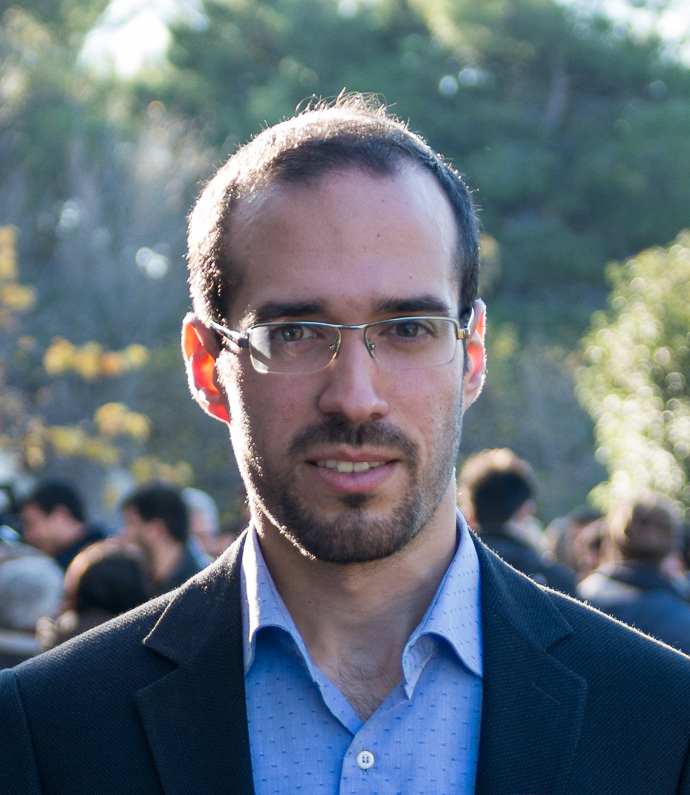
Panagiotis Tsinganos
Senior Machine Learning Engineer specializing in high-performance Edge AI and Computer Vision. I deliver real-time deep learning solutions for resource-constrained environments, with a proven track record of optimizing model latency and architecting robust telematics pipelines. I bridge the gap between advanced research in signal processing and scalable, production-grade software engineering for startups and high-growth teams.
Experience
dreyev
Senior Software Engineer (Machine Learning) • Jan, 2022 — Jan, 2026
| *US-based Automotive AI Startup | Real-time Driver Safety & Telematics* |
Led the architecture and optimization of edge-based Computer Vision systems for real-time driver attention management, collaborating with a small cross-functional engineering team and reporting to the CTO.
- Inference Optimization: Replaced standard TFLite interpreters with a custom native C++ engine using the ncnn framework, reducing model latency and enabling 15FPS road object detection on mid-range Android devices.
- Model Engineering: Enhanced object detection accuracy through targeted dataset annotation and fine-tuning of TensorFlow models for complex driver state monitoring tasks.
- Sensor Fusion: Designed and implemented multi-modal driving score algorithms by fusing high-frequency IMU, GPS, and CV event streams to provide real-time safety feedback.
- Pipeline Management: Orchestrated the end-to-end telematics data pipeline, managing the collection and processing of real-time driving data.
Skills
Programming languages
Python, Java/Kotlin (Android), Matlab, HTML, JavaScript, C/C++
Machine Learning & AI
TensorFlow, PyTorch, Scikit-learn, MLflow, Deep Learning, Model Optimization, Quantization, Inference, Transfer Learning
Edge AI & Embedded ML
ncnn, ONNX Runtime, TensorFlow Lite, Hardware Acceleration, Mobile ML Deployment
Computer Vision & Sensors
Road Object Detection, Driver State Monitoring, YOLO models, Sensor Fusion (IMU, GPS), Telematics
Cloud
Docker
Mobile Development
Android SDK/NDK, JNI, Native code optimization
Signal Processing
Image Processing, Digital Signal Processing, Biomedical Signals (sEMG, ECG), Wearable Sensors
Web Development
Flask, REST API, React
Communication protocols
TCP/IP, GSM, MQTT
Education
University of Patras, Greece – Vrije Universiteit Brussel, Belgium
Doctor of Philosophy and Doctor of Engineering Sciences (Joint PhD / Cotutelle) • 12/2017 — 11/2021
Full-time PhD Research & Teaching Residency focusing on high-accuracy gesture recognition systems.
Research Highlights:
- Developed novel Temporal Convolutional Network (TCN) architectures in Tensorflow, achieving 90% classification accuracy in discriminating between 53 classes.
- Engineered a low-latency gesture control interface (sub-100ms) for the ENHANCE project, directly improving user engagement in clinical trials.
- Coordinated international research initiatives with VUB (Belgium), resulting in shared datasets and a joint doctorate.
Teaching & Mentorship:
- Mentored 10+ undergraduate theses in AI/Signal Processing, leading to 5 published conference papers and successful industry placements.
- Developed and taught hands-on labs for Machine Learning and Digital Signal Processing using Python and MATLAB.
- Andreas Mentzelopoulos Scholarships for the University of Patras
Thesis title: «Multi-channel EMG pattern classification based on deep learning»
University of Patras, Greece
MSc Degree in Biomedical Engineering • 10/2015 — 6/2017
Thesis title: «Smartphone-based fall detection system for the elderly»
Grade: 9.02/10
University of Patras, Greece
Diploma in Electrical and Computer Engineering • 10/2010 — 10/2015
Thesis title: «Transmission of biomedical signals using a wireless sensor network»
Grade: 8.31/10
Certifications
AI-Powered Software Engineer
Udacity • 2026
Completed the Udacity Nanodegree program focused on integrating AI into the software development lifecycle, utilizing LLMs for code generation, and building AI-enhanced applications.
PyTorch for Deep Learning
DeepLearning.AI • 2026
Mastered fundamental and advanced concepts of deep learning using the PyTorch framework.
MCP: Build Rich-Context AI Apps with Anthropic
DeepLearning.AI • 2026
Learned the core concepts of MCP and how to build AI applications using it.
Building Coding Agents with Tool Execution
DeepLearning.AI • 2025
Acquired advanced skills in developing autonomous agents capable of interacting with APIs and tools.
Udacity AI for Healthcare Nanodegree
Udacity • 2020
Completed a nanodegree focusing on AI applications in healthcare.
Udacity Full Stack Developer Nanodegree
Udacity • 2020
Completed a nanodegree covering front-end and back-end web development.
Publications
P. Tsinganos, B. Jansen, J. Cornelis and A. Skodras, “Real-Time Analysis of Hand Gesture Recognition with Temporal Convolutional Networks”, Sensors, MDPI, 22(5), 1694, 2022.
P. Tsinganos, B. Cornelis, J. Cornelis, B. Jansen and A. Skodras, “Data Augmentation of Surface Electromyography for Hand Gesture Recognition”, Sensors, MDPI, 20(17), 4892, 2020.
P. Tsinganos, B. Cornelis, J. Cornelis, B. Jansen and A. Skodras, “Improved Gesture Recognition Based on sEMG Signals and TCN”, 2019 IEEE International Conference on Acoustics, Speech and Signal Processing (ICASSP), Brighton, UK, 2019, pp. 1169–1173.
P. Tsinganos and A. Skodras, “On the Comparison of Wearable Sensor Data Fusion to a Single Sensor Machine Learning Technique Fall Detection”, Sensors, MDPI, 18(2), 592, 2018.
Full list of 12+ peer-reviewed publications available on, Google Scholar, .
Projects
Luminous TCG — Agentic Discovery Engine
Creator - Lead Developer • 2026
Developed a sophisticated visual and metadata discovery engine for Pokémon TCG, combining multimodal retrieval and agentic search orchestration.
- Agentic Search Orchestration: Engineered a stateful search agent using LangGraph to process complex natural language queries, handle multi-turn dialogue, and resolve user search intent.
- Multimodal Retrieval: Integrated CLIP vision-language embeddings via Hugging Face to enable semantic search by visual composition, color palette, and abstract thematic vibes.
- Backend Microservice: Implemented a high-performance FastAPI REST backend to coordinate the agent state, query TCGdex metadata, and serve vector embeddings.
- Modern Frontend: Developed a responsive discovery interface using React and Vite to display multi-dimensional card relationships.
EMG-based Hand Gesture Recognition for Rehabilitation (ENHANCE)
Researcher - Developer • Sep. 2020
Supervised the development of a serious game controlled by a surface electromyography (sEMG) interface for rehabilitation purposes
Smartphone-based fall detection system for the elderly
Researcher - Developer • Sep. 2016 — Jun. 2017
Implemented an Android app that detects when an elderly user has fallen and automatically alerts their selected emergency contacts
- Developed a sensor fusion algorithm in Java/Android that integrated accelerometer and gyroscope data to distinguish between “Activities of Daily Living” (ADLs) and actual falls.
Recognition
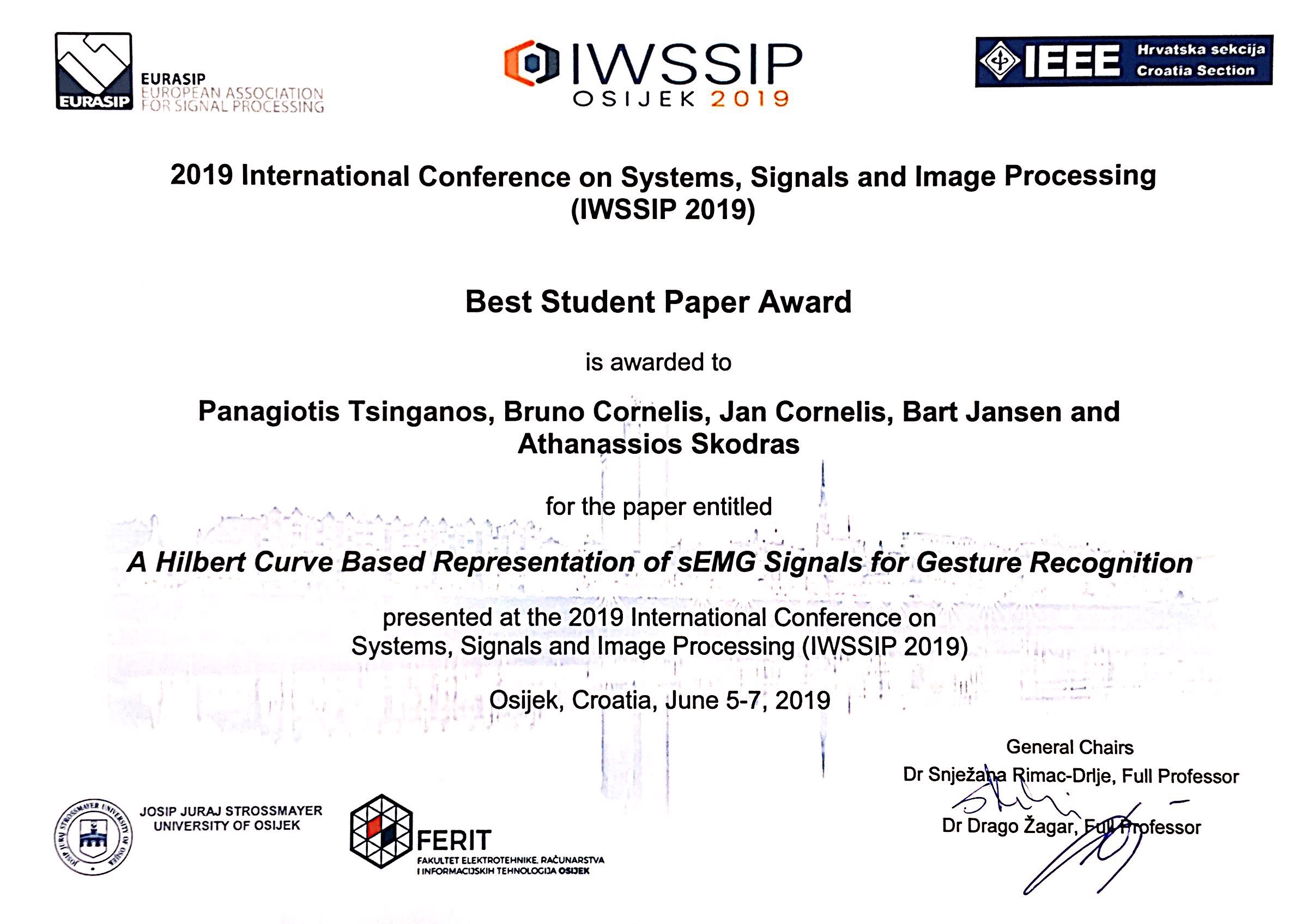
Best Student Paper
IEEE, EURASIP, University of Osijek, FERIT • 2019
Awarded for the paper with title “A Hilbert Curve Based Representation of sEMG Signals for Gesture Recognition” presented in IWSSIP 2019 Osijek, Croatia.
Outside Interests
- Photography
- Painting
- Cycling
- Music
Social Links
- Github: https://github.com/ptsinganos
- LinkedIn: https://gr.linkedin.com/in/ptsinganos